

The Thinker Sculpture: Rodin’s Bronze Masterpiece and Its Enduring Power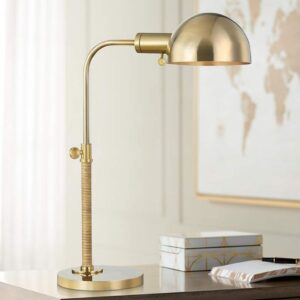
Few sculptures in the world communicate as immediately and as universally as The Thinker. You know it before you know its name — the slumped posture, the elbow on the knee, the chin resting on the fist, the weight of thought made physical in dark bronze. Rodin’s figure is not the classical thinker: upright, serene, intellectually confident. It is the real one: hunched under the burden of understanding, the body shaped by the effort of the mind. The thinker sculpture achieves what all great art achieves — it makes an invisible thing visible, gives physical form to an experience that has no physical form. The Aged Brass Dome Adjustable Desk Lamp ($269–$409) is the lamp for the desk of anyone who recognizes what Rodin made here: adjustable, purposeful, built for sustained work.
The thinker sculpture covers the history of Rodin’s Thinker — its origin as part of the monumental Gates of Hell commission, its transformation from a specific figure into a universal symbol, the many cast versions that exist worldwide, and the design principles it embodies. It also addresses the question that genuine art always raises: what does this work ask of me, and how does understanding it change how I see the world? Browse our sculptural table lamps for lamp designs suitable for a study or library where that kind of question is taken seriously.
Origin: The Thinker as Part of The Gates of Hell
Rodin received the commission for The Gates of Hell in 1880 — a monumental bronze door for a planned decorative arts museum in Paris that was never built. Taking Dante’s Inferno as his source, Rodin conceived the gates as a compendium of human suffering and desire, populated by dozens of figures. The Thinker was originally conceived as the poet Dante himself, sitting above the gates and looking down on the hell he was describing. At this stage the figure was known as The Poet. Rodin enlarged it to standalone scale and it became what we now know: not a specific literary figure but a universal one. The bronze figure we recognize today has no identity — it is any mind grappling with any question. The dark, precise finish of the Aged Gunmetal Fluted Table Lamp ($299–$449) in aged gunmetal creates the material register appropriate to a room that takes intellectual work seriously.
The Gates of Hell commission consumed Rodin for the rest of his life — he was still working on it when he died in 1917, and the gates were never installed in his lifetime. The Thinker, however, achieved an independent life far beyond the commission. The first large-scale cast was exhibited at the Salon in 1904 to extraordinary response, and Rodin donated it to the city of Paris in 1906. It was placed outside the Panthéon — the building where France’s intellectual and artistic heroes are entombed — making the symbolic location as resonant as the work itself. The Bronze Accent Table Lamp ($239–$359) in warm aged bronze accent is the material echo of Rodin’s original: the warm dark metal that carries both weight and warmth.
The Thinker Sculpture: Form, Posture, and Meaning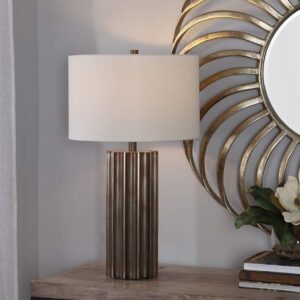
What Rodin did with the Thinker’s posture was revolutionary and remains unique. A classical philosopher sits upright, radiating composed authority. A Cartesian cogito thinker would be disembodied, thought occurring somewhere above the body. Rodin’s piece has the body slumped under the actual physical weight of thought — the back bent, the shoulders rounded, the musculature of the arm carrying the head’s burden. The figure is not thinking effortlessly; it is thinking with every muscle. This physical commitment to the experience of thinking — this refusal to separate mind from body — is what makes the piece so immediately recognizable to anyone who has ever worked hard at a difficult problem. The Aged Black Table Lamp ($269–$409) in aged black has this same quality of physical commitment: it doesn’t float above its purpose, it grounds it.
The Thinker Sculpture in Homes, Studies, and Collections
The Thinker is one of the most widely reproduced sculptures in history. Authorized cast bronze versions exist at the Musée Rodin in Paris, the Cleveland Museum of Art, the National Museum of Western Art in Tokyo, Stanford University, and dozens of other institutions. Smaller authorized and replica versions are available from estate and museum sources. A study or library that includes a quality replica of this bronze figure — even a 6-inch desk version — acquires something specific: not just decoration but a statement about the values of the space. What happens at this desk matters. The Aged Brass Dome Adjustable Desk Lamp ($269–$409) beside it ensures that what happens there is properly illuminated.
For the room that takes Rodin seriously — that aspires to the quality of thought the Thinker represents — the material palette should be dark, warm, and honest: aged bronze, dark wood, aged leather, linen. No chrome, no bright white, no aggressively contemporary surfaces. The dark materials create the contemplative atmosphere that the figure demands. Browse our table lamps collection for the full range of lamp designs suited to a library or study with serious design intentions.
For the complete guide to famous sculptures across all eras and what they mean for home design, see our famous sculptures guide.
Frequently Asked Questions
Where is the original Thinker sculpture located?
The most famous cast of The Thinker is at the Musée Rodin in Paris, where Rodin worked and where the largest collection of his work is held. There are over 20 large-scale authorized bronze casts worldwide, including at the Cleveland Museum of Art, the National Museum of Western Art in Tokyo, Stanford University’s Cantor Arts Center, and the Rodin Museum in Philadelphia. Rodin authorized multiple casts during his lifetime and in his will, making The Thinker one of the most multiply-reproduced major sculptures in existence.
What does The Thinker sculpture represent?
The Thinker originally represented the poet Dante, looking down over the Gates of Hell that Rodin was commissioned to create for a Paris museum. As Rodin enlarged and separated the figure from the gates, it became something more universal: any mind grappling with any question, the body physically engaged in the effort of thought. The posture — slumped, musculature tense, elbow on knee — communicates that real thinking is physical work, not a serene mental activity separate from the body.
What material is The Thinker made from?
The Thinker is cast in bronze using the lost-wax casting method, which captures surface detail at a level that no other casting technique matches. The dark patina — a controlled chemical process applied after casting — gives the work its characteristic dark warm tone. Rodin worked extensively with bronze throughout his career, valuing its ability to hold both fine surface detail and the large-scale structural tension his figures required.
How large is The Thinker sculpture?
The most common large-scale version of The Thinker stands approximately 72 inches (182 cm) tall on its base, making it approximately life-size. This version is the one found at major museum collections. Smaller versions ranging from 15 to 24 inches are available as authorized museum reproductions. A desk-scale version of 6 to 10 inches is the most appropriate for a study or home library display.