

Contemporary Sculpture Artists and Home Collectors Guide: From Kapoor to Emerging Art
A contemporary sculpture artists and home collectors guide starts with a paradox: the most famous living sculptors are largely inaccessible to most home collectors. Anish Kapoor’s stainless steel mirrored forms sell for millions. Jeff Koons’s balloon sculptures command record auction prices. Damien Hirst’s spin paintings and dot paintings are available at lower price points, but his major sculptural works remain institutional. The practical guide for most home collectors is not how to acquire these works but how to understand what they mean — and how that understanding shapes the choices available at accessible price points. The Aged Brass Metal Modern Accent Table Lamp ($339–$509) in slim aged brass modern accent is the lamp whose formal resolution belongs in the room of a collector who has done this intellectual work.
This guide covers the contemporary sculpture artists and home collectors guide for understanding major figures (Kapoor, Hirst, Koons, Kara Walker, Rachel Whiteread), how to start a sculpture collection at accessible price points, and the principles of art market navigation for serious home collectors. Browse our table lamp collection for lamp designs suited to contemporary collector’s rooms.
Contemporary Sculpture Artists and Home Collectors Guide: Major Figures
Understanding Anish Kapoor sculpture influence on contemporary design means understanding his central subject: the boundary between solid and void, the space inside a thing. Cloud Gate (Chicago Bean) inverts the observer’s relationship to their surroundings by creating a mirrored surface that reflects the city in a distorted, non-Cartesian space. His Descent into Limbo creates a void that appears to have no bottom. These works create conceptual disorientation as their primary aesthetic content. For home collectors, Kapoor-influenced work can be found in mirrored ceramic objects, concave polished metal forms, and objects that use reflective surfaces to incorporate the viewer’s environment into the work.
Jeff Koons sculpture home decor influence is visible in the normalization of domestic objects — balloon dogs, basketballs, vacuum cleaners — as serious art subjects. Koons’s fundamental claim is that popular culture objects have the same formal dignity as any high-art subject. For home decoration, this means that the collector who treats an everyday form with the same material seriousness that Koons treats his Balloon Dog — in high-quality material, at the right scale, in the right room — is applying exactly the Koons principle. The Cobalt and Natural Brass Table Lamp ($269–$409) in cobalt glass and natural brass belongs beside this kind of collected-with-conviction everyday object: both say that material quality matters regardless of the subject’s prestige level.
How to Start a Sculpture Collection at Home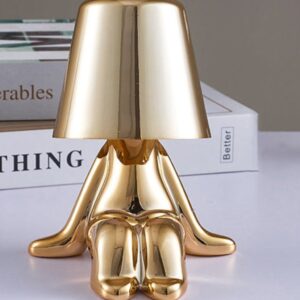
How to start a sculpture collection at home follows five practical steps. Step one: identify the formal tradition you are drawn to — classical figurative, abstract geometric, organic abstract, conceptual, or cultural-tradition sculpture. Step two: set a realistic acquisition budget for your first three pieces (not one — buying one piece before understanding how three pieces would relate to each other leads to incoherent collections). Step three: acquire from three sources over the first year — one major museum store reproduction, one gallery-acquired contemporary work, and one artist-direct purchase.
Step four: display deliberately — give each piece its own territory, adequate negative space, and the correct side light from a well-chosen lamp. The display is as important as the acquisition. Step five: review the collection after three pieces and ask: what formal conversation are these three pieces having? If there is no conversation, the collection is accumulation rather than collection. The Aged Gunmetal Fluted Table Lamp ($299–$449) in aged gunmetal at the wall lamp position creates the contained focused light for a collector’s room where these decisions are made and remade.
Sculpture Investment and the Contemporary Art Market
Contemporary sculpture artists and home collectors guide to art market navigation covers one essential principle: buy what you love with the best budget available, understand the market as a secondary consideration, and never buy primarily as an investment unless you are a professional art market participant. Sculpture investment for home collectors is a legitimate secondary consideration — works by significant artists have historically appreciated — but the primary criterion must be the piece’s formal quality and your genuine engagement with it.sculptural table lamps
Contemporary art market sculpture prices for accessible-budget collectors are most favorable in three categories: editions by major artists (limited edition prints and sculpture casts are significantly more affordable than unique works), works by emerging sculpture artists to collect (artists in the five to fifteen years post-art school, represented by their first or second gallery, before their prices have risen), and culturally specific traditional sculpture from living master artists. The Aarna Black Table Lamp ($269–$409) in matte black aarna beside an edition print or a work by an emerging sculptor creates the composed room that shows the collector has understood the principles.
Emerging Sculpture Artists to Collect Today
Emerging sculpture artists to collect combine formal intelligence with prices that are accessible before critical and commercial recognition drives them upward. Signs of emergence: shown at credible gallery fairs (Frieze, Art Basel, NADA), reviewed in art publications, acquired by one or more public collections. The period between an artist’s first solo show and their first inclusion in a major art fair is the window where quality acquisition is most affordable.
For a home collector, an emerging artist’s work has an additional quality beyond its financial upside: it communicates a specific kind of engagement with the art world — a willingness to research, to form opinions, and to commit to a vision before the market has done that work for you. This kind of collecting creates the most personally meaningful rooms. Browse our floor lamp collection for the lamp designs suited to the collector’s room that communicates these values.
A contemporary sculpture artists and home collectors guide ultimately teaches that collecting is a practice of developing judgment over time — there is no shortcut, no definitive list, no authority whose approval substitutes for your own careful looking. The room that results from this practice communicates more than any room created by following external advice. Browse our full lamp collection for the lamp collection that serves these rooms.
Frequently Asked Questions
How do you start collecting sculpture at home?
Five steps: identify the formal tradition you are drawn to; set a budget for your first three pieces (not one); acquire from three sources over the first year (museum reproduction, gallery acquisition, artist-direct purchase); display deliberately with adequate negative space and correct side lighting; and review the collection after three pieces — ask what formal conversation they are having. If there is no conversation, it is accumulation rather than collection.
What living sculptors should home collectors know about?
Anish Kapoor (mirrored forms, the boundary between solid and void), Jeff Koons (elevation of everyday objects to high-art formal dignity), Damien Hirst (mortality and spectacle), Rachel Whiteread (cast negatives of domestic spaces), Kara Walker (silhouettes and narrative), and Richard Serra (large-scale steel in space). Most of these artists’ major works are institutional, but understanding their formal projects helps collectors identify work at accessible price points that shares their values.
Is buying sculpture a good investment?
Works by significant artists have historically appreciated, making sculpture investment for home collectors a legitimate secondary consideration. But the primary criterion must always be the piece’s formal quality and your genuine engagement with it. The most reliable value retention is in: editions by major artists with limited print runs, works by artists already in one or more public collections, and culturally specific traditional sculpture from recognized living master artists. Never buy primarily as an investment unless you are a professional art market participant with access to specialist knowledge.