

Famous Sculptors and Their Influence on Home Decor: A Cultural Collector’s Guide
Understanding famous sculptors and their influence on home decor is the fastest way to develop a genuine eye for sculptural art. When you know who Rodin was and what he was trying to achieve, a bronze figurine in the Rodin tradition communicates more. When you understand Brancusi’s formal project, an abstract smooth-form sculpture stops being “just a shape” and becomes a position in a specific conversation about what sculpture can do. Informed collectors make better choices. The Possini Euro Zeus Gold Leaf Modern Table Lamp ($319–$479) in warm gold leaf belongs in any room where someone has made that kind of considered choice — a lamp that earns its place as art.
This guide covers famous sculptors and their influence on home decor across the major traditions — ancient Greek, Renaissance Italian, 19th-century French, 20th-century modernist, and global cultural sculpture. Each section explains what the tradition valued, who its most important practitioners were, and how that tradition lives in contemporary home decoration choices. Browse our sculptural lamp collection for sculptural lamp designs whose material and formal vocabulary connects to these same traditions.
Famous Sculptors and Their Influence on Home Decor: The Classical Tradition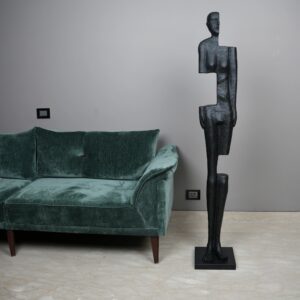
Any survey of famous sculptors and their influence on home decor begins with ancient Greece. The great sculptors of all time — Phidias (creator of the Statue of Zeus at Olympia), Praxiteles (the first sculptor to depict the female nude), and Lysippos (who changed the proportional canon of the human figure) — established the vocabulary of Western sculpture that everything since has either built on or pushed against. Their formal principles are still visible in any classical-tradition figurative sculpture purchased for a home today.
Classical sculptors for home decor influence is most visible in the collector’s preference for warm material, resolved proportion, and idealized subject matter. A marble bust with confident bone structure and a calm expression, a bronze athlete at ease in contrapposto — these are pieces in the Phidian tradition, whether the sculptor knew it or not. The Aged Brass and Ceramic Affogato Table Lamp ($289–$439) in warm aged brass and ceramic Affogato belongs beside this kind of classical-tradition figure: the warm formal presence creates the same quality of resolved authority.
Sculpture Movements in Art: Renaissance and Baroque
Sculpture movements in art underwent their most transformative development in Renaissance and Baroque Italy. Donatello’s David (1440) was the first free-standing bronze nude since antiquity — it reestablished that sculpture could exist independently of architecture. Michelangelo’s David (1504) raised the technical and expressive ceiling to a height that had not been reached before and arguably has not been equaled since. Bernini’s baroque sculptures (1620s–1670s) added psychological intensity and physical drama that the Renaissance’s dignified restraint had deliberately withheld.
The sculpture heritage in design from the Renaissance and Baroque periods is most visible in the enduring collector preference for marble and bronze as primary sculptural materials — materials these masters used with incomparable skill — and for figurative subjects treated with psychological depth rather than symbolic abstraction. How sculpture influences interior design from this tradition: rooms built around a significant marble or bronze figurative piece communicate a specific engagement with Western art history. The Bronze Accent Table Lamp ($239–$359) in warm bronze accent is the lamp companion for this kind of room.
19th-Century French Sculptors: Rodin and the Modern Turn
Auguste Rodin (1840–1917) is the pivot point of sculpture art history for home collectors. His work stands at the boundary between the classical tradition and modern sculpture: technically more accomplished than anyone since Michelangelo, formally experimental in a way that anticipates the abstract 20th century. The Thinker (1904) is the most recognized sculpture in the world, and its image — the figure folded into intense thought — communicates directly to anyone who encounters it, regardless of art historical knowledge. A quality Thinker reproduction on a study desk or bookshelf communicates more than almost any other single sculptural choice.
Camille Claudel, Rodin’s student and one of the great sculptors of all time in her own right, produced work of equal technical quality with more personal and psychological intensity. Her pieces are rarer in reproduction but worth seeking. The Aged Brass Dome Adjustable Desk Lamp ($269–$409) in warm dome desk lamp beside a Thinker or Claudel reproduction at the study desk creates the focused, intellectually serious room composition that this tradition deserves.
Modern Sculptors Influence on Decor: The 20th Century
The famous sculptors and their influence on home decor most visible in contemporary decoration come from the early-to-mid 20th century: Brancusi’s formal reductivism, Henry Moore’s biomorphic humanism, Alberto Giacometti’s existential anxious figures, Alexander Calder’s kinetic mobiles. Each of these artists established a new formal vocabulary that subsequent decorative objects drew from — often without the decorator knowing the source. An organic abstract form on a contemporary console is, in most cases, either directly inspired by Moore or Brancusi or has been influenced by design objects that were directly inspired by them.
Modern sculptors influence on decor reaches its widest expression through the studio ceramics and design object industries. Calder’s colors and mobiles were immediately absorbed into children’s room design; Moore’s biomorphic forms influenced every organic modern furniture silhouette of the 1950s and 1960s; Brancusi’s reductive precision is visible in every high-end minimal ceramic lamp base and decorative object made in the last 60 years. The Aarna Black Table Lamp ($269–$409) in matte black aarna is this influence at lamp scale: the total formal resolution belongs directly to the Brancusian tradition of maximum effect from minimum means.
Famous Sculpture Styles for Home: Global Traditions
Famous sculpture styles for home decoration extend well beyond the Western European tradition. Japanese Buddhist sculpture, dating from the Asuka period (6th–7th century AD) through to the Edo period, established formal vocabularies for representing spiritual states — the compressed serenity of the seated Amida, the fierce protective energy of the Fudō Myōō — that have influenced interior decoration far beyond Japan. An authentic or quality reproduction Buddhist sculpture in a home communicates its tradition’s specific spiritual intention, not just its aesthetic quality.
West African sculpture — the Benin Kingdom bronzes, Yoruba figurative sculpture, Kuba Kingdom textiles and objects — was a direct and acknowledged influence on Picasso, Matisse, and the European modernist revolution. The formal properties African sculpture exploited — abstracted geometry, multiple simultaneous viewpoints, spiritual presence over anatomical accuracy — were precisely the innovations European modernism claimed to discover. Sculpture art history for home collectors is richer for understanding this lineage. The Adobe Brown Chisel Ceramic Table Lamp ($269–$409) in earthy adobe brown beside an African or African-influenced sculptural object creates the warm, grounded lamp companion for this design tradition.
How to Use Art History as a Collecting Framework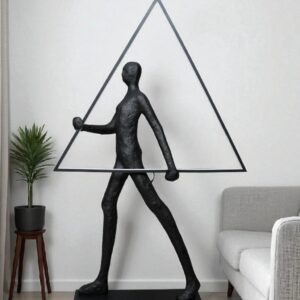
Art history sculpture guide principles translate directly into practical collecting guidance. The most useful question for any sculpture purchase is: what tradition does this piece belong to, and how fluently does it speak that tradition’s formal language? A piece that belongs to a recognizable tradition but handles its formal vocabulary awkwardly is a weaker choice than a piece that belongs to the same tradition and handles it with confidence.
The second most useful question is: what tradition does my room belong to, and does this piece’s tradition create resonance or friction with the room’s existing design language? A Rodin-tradition bronze in a room built on mid-century modern principles creates productive friction. The same bronze in a formal traditional room creates resonance. Neither outcome is wrong — but understanding the distinction allows you to make the choice deliberately. Browse our sculptural table lamps for the sculptural lamp designs suited to rooms in every tradition discussed in this guide.
Famous sculptors and their influence on home decor is ultimately the story of how human beings have used three-dimensional form to communicate what language cannot — spiritual presence, physical perfection, psychological depth, formal beauty. Every quality sculpture in a home participates in this conversation across time. The lamp beside it should be chosen with the same understanding of material, tradition, and form. Browse our full lamp collection for the complete lamp collection.
Frequently Asked Questions
Who are the most influential sculptors in history?
The most historically influential sculptors are: Phidias (ancient Greece — established Western ideal proportion), Praxiteles (ancient Greece — introduced psychological naturalism), Donatello (Renaissance Italy — reestablished free-standing bronze), Michelangelo (Renaissance Italy — technical and expressive apex of Western figurative sculpture), Bernini (Baroque Italy — psychological drama in marble), Rodin (19th-century France — bridge between classical tradition and modern sculpture), Brancusi (early 20th century — reductive abstraction), and Henry Moore (20th century — biomorphic humanism in large-scale sculpture).
How does art history help when choosing sculpture for a home?
Art history provides a framework for identifying which formal tradition a sculpture belongs to and how fluently it speaks that tradition’s vocabulary. A piece that belongs recognizably to a tradition (Rodin-style bronze, Brancusi-style abstract, classical-tradition marble) but handles its formal elements clumsily is weaker than a piece that handles the same tradition with confidence. Understanding the tradition also tells you which rooms and material contexts the piece will resonate with and which it will create friction in.
What reproduction sculptures are worth buying for a home?
Quality reproductions of Rodin bronzes (The Thinker, The Kiss, The Gates of Hell details) are among the most valuable sculpture reproduction purchases for a home — the Rodin tradition translates well into quality cold-cast bronze and polyresin at every price point. Classical Greek and Renaissance figures in quality composite marble are equally worthwhile. African and Asian traditional sculpture reproductions are best sourced from culturally connected manufacturers. Always check: is the surface quality consistent? Does the piece have appropriate weight? Are the proportions correct?
What is the relationship between African sculpture and modern art?
West African sculpture — particularly the Benin Kingdom bronzes and Yoruba figurative sculpture — directly influenced the European modernist revolution of the early 20th century. Picasso, Matisse, Braque, Kirchner, and many others drew directly on African sculptural formal principles: geometric abstraction over anatomical accuracy, multiple simultaneous viewpoints in a single form, spiritual presence as a formal quality. This influence is now well-documented and acknowledged by art historians. A home that includes African sculpture alongside European modern art is displaying one of the most important dialogues in 20th-century cultural history.