

Unusual lamp shades are one of the fastest ways to transform a table lamp from a background fixture into a genuine design statement. Most rooms default to white drum or empire shades — functional, neutral, forgettable. But the shade is where a lamp’s visual personality lives: its colour, its texture, its silhouette, and the quality of light it casts. Choosing an unusual shade is choosing a point of view. At Exotic Decor USA, our table lamps collection includes lamps already paired with 15 of the most distinctive shade designs available — from traditional stained glass to modern sculptural forms. Here is each one, what it does to a room, and where it works best.
Stained Glass and Art Glass Shades
- TIFFANY STAINED GLASS — THE JEWEL-TONED CLASSIC
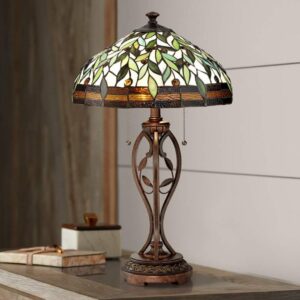
The most recognisable unusual lamp shade in American decorating. Hand-soldered art glass segments in jewel tones — amber, cobalt, emerald, ruby — cast coloured light across walls and ceilings. Each shade is unique due to hand construction. The effect is atmospheric, warm, and impossible to replicate with any other material.
BEST FOR: Traditional studies, libraries, dark wood-panelled rooms, eclectic and maximalist living rooms
Tiffany table lamps and table tiffany style lamps are available in our range across multiple colourways — floral patterns, geometric panels, and dragonfly motifs are the most popular. The tiffany style table lamp category is consistently our most visited for unusual shade designs.
- FUSED ART GLASS — ABSTRACT AND CONTEMPORARY
Where Tiffany is representational and traditional, fused art glass shades are abstract and contemporary. Molten glass layers are fused together, creating organic colour transitions and surface textures that are unique to each firing. They work with modern lamp bases and produce a soft, diffused coloured glow rather than the sharp jewel-toned cast of leaded Tiffany glass.
BEST FOR: Contemporary living rooms, eclectic bedrooms, open-plan spaces with neutral furniture
- MERCURY GLASS SHADE — REFLECTIVE AND ATMOSPHERIC
Mercury glass shades are coated with a silver-like metallic layer on the interior surface, producing a vintage, mirror-like quality that reflects light softly back into the room. A mercury glass table lamp produces a dim, intimate, candlelight-adjacent glow — best used as an accent lamp alongside a brighter primary light source.
BEST FOR: Bedrooms, dressing rooms, Hollywood Regency and glam living rooms
A mercury glass table lamp shade creates a distinctly different atmosphere from clear glass, where clear glass transmits light outward, mercury glass reflects it inward, producing a warmer, more contained glow that suits intimate room arrangements.
Colored Fabric and Textured Shades
- GREEN LAMP SHADE — THE LIBRARY CLASSIC
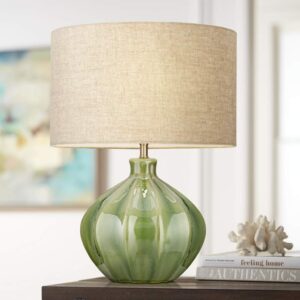
A green lamp shade — particularly in rich forest or hunter green — is one of the most atmospheric shade choices available. It produces a warm, verdant glow associated with traditional banker’s lamps, English country libraries, and art deco studies. A green shade on a brass base is among the most iconic table lamp pairings in American decorating history.
BEST FOR: Home offices, libraries, studies, dark academic interiors, traditional living rooms
Green table lamps and table lamps green consistently rank among the most-searched shade colours — and it is the green lamp shade specifically that drives most of that search behaviour. The shade colour is the defining feature; the base is secondary. Our green ceramic table lamp ($339–$479) pairs a rich green shade with a mid-century ceramic base — one of our most-requested items.
- ORANGE AND AMBER SHADE — WARM, SATURATED, BOLD
Orange and amber shades were a defining feature of 1960s and 1970s Scandinavian and Italian lamp design. They produce an intensely warm, sunset-toned light that transforms a neutral room. An orange shade on a concrete or wooden base is a statement that reads as confidently retro-modern.
BEST FOR: Mid-century modern rooms, Scandinavian interiors, eclectic living rooms, reading corners
An orange table lamp with a saturated amber shade is not a subtle choice — it is a deliberate focal point. Use it as the single most chromatic object in an otherwise restrained room for maximum effect.
- LIGHT BLUE SHADE — CALMING AND COASTAL
A light blue lamp shade produces a soft, cool-toned glow that reads as tranquil and airy. It works in coastal rooms, Scandinavian interiors, and any bedroom where the design goal is calm. A light blue shade on a white or natural ceramic base creates the quintessential seaside bedroom lamp.
BEST FOR: Coastal rooms, beach houses, Scandinavian bedrooms, meditation and reading spaces
A light blue table lamp shade is one of the most requested in coastal styling — it evokes open water, summer light, and air. For a nautical version, pair a light blue shade with a rope-wrapped or driftwood base.
- RUFFLED FABRIC SHADE — ROMANTIC AND MAXIMALIST
Ruffled and pleated fabric shades produce a distinctly feminine, romantic visual texture that is impossible to replicate with any other shade style. They suit traditional bedroom lamps, grandmillennial rooms, and maximalist arrangements where layered texture is the design language.
BEST FOR: Traditional and transitional bedrooms, grandmillennial living rooms, cottagecore and romantic interiors
- BLOCK PRINT FABRIC SHADE — ARTISAN PATTERN
Block-printed fabric shades carry hand-stamped geometric or botanical patterns — typically in Indian woodblock or West African resist-print traditions. The pattern appears on the shade exterior and casts subtle shadows through the fabric when lit. They suit bohemian, global-inspired, and artisan-modern interiors.
BEST FOR: Bohemian living rooms, global-inspired spaces, artisan and handmade aesthetic rooms
Sculptural and Structural Shades
- CAGE SHADE — INDUSTRIAL AND EXPOSED
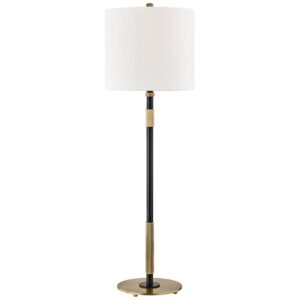
A cage shade is an open metal frame — typically in black, gunmetal, or brass — that holds the bulb fully exposed within a geometric armature. It produces hard, directional light with visible shadows from the cage structure. It is the defining shade choice for industrial table lamps and urban-modern aesthetics.
BEST FOR: Industrial loft rooms, urban-modern living rooms, masculine home offices, dark academic interiors
A modern black table lamp with a cage shade eliminates the shade from the silhouette almost entirely — the lamp becomes a piece of architectural metalwork that happens to hold a light. The Aged Gunmetal Fluted Table Lamp ($299–$449) achieves a similar structural quality with its architectural fluted column base.
- WOVEN RATTAN SHADE — ORGANIC TEXTURE
A rattan or woven grass shade produces a distinctive dappled light pattern through its woven gaps — warm and patterned against walls and ceilings when lit. This unusual lamp shade works with natural material bases and suits bohemian, coastal, and tropical-inspired interiors strongly.
BEST FOR: Bohemian rooms, coastal interiors, tropical and global aesthetic spaces, Japandi rooms
A rattan table lamp with a woven rattan shade is one of the most cohesive natural-material lamp pairings — base and shade unified in the same organic material family. The light effect through the weave produces natural, shadow-patterned warmth that no solid fabric shade can replicate.
- PAPER AND WASHI SHADE — JAPANESE SOFT GLOW
Washi paper and rice paper shades produce a uniquely soft, diffused glow — light that spreads evenly through the entire shade surface rather than concentrating at the base or projecting downward. Japanese paper table lamps are meditative in quality, creating a warm ambient presence rather than directional light.
BEST FOR: Japandi interiors, wabi-sabi rooms, meditation spaces, minimal bedrooms
A Japanese table lamp with a washi paper shade is one of the most distinctive, unusual lamp designs available — completely unlike any Western shade tradition. The material is fragile and not suited to high-heat bulbs; always use LED bulbs (max 40W equivalent) with paper shades.
Artisan and Speciality Shades
- ALABASTER SHADE — TRANSLUCENT STONE
Alabaster — the pale, milky metamorphic stone — can be cut thin enough to allow light to pass through it, producing a warm, amber-tinted glow with visible stone veining patterns backlit by the bulb. It is one of the rarest and most luxurious shade materials available. Each shade is carved from a single piece of natural stone.
BEST FOR: Luxury bedrooms, quiet luxury living rooms, high-end hotel-style interiors
An alabaster table lamp shade is an investment-level choice — the material is genuinely rare, the manufacturing process is labour-intensive, and the result is unlike any fabric or glass shade. The warm stone glow cannot be replicated artificially.
- SCALLOPED EDGE SHADE — VINTAGE DETAIL
Scalloped edges — the decorative curved notches along the lower rim of the shade — are a period detail associated with Victorian, Edwardian, and 1940s–1950s American table lamp design. They are experiencing a strong revival in grandmillennial and retro-modern rooms. The scalloped silhouette softens the shade outline and adds a hand-crafted quality even to machine-made fabric shades.
BEST FOR: Traditional and grandmillennial rooms, vintage-inspired bedrooms, cottagecore and romantic interiors
- SQUARE AND RECTANGULAR SHADE — ARCHITECTURAL GEOMETRY
Square and rectangular shades create a deliberately angular, architectural silhouette that contrasts with the rounded forms of most lamp bases. They suit art deco table lamps, black and gold geometric bases, and any lamp where the shade is meant to create visual tension with the base rather than harmonise with it.
BEST FOR: Art deco rooms, geometric and angular interior schemes, contemporary and minimalist spaces
An art deco table lamp with a rectangular shade is a particularly strong pairing — the geometric angularity of the shade echoes the stepped, geometric forms typical of 1920s and 1930s design language. The Adeline Five Gold Flowers Bloom Metal Table Lamp ($269–$409) shows how a sculptural base paired with a clean rectangular shade creates maximum design impact.
- MULTI-TIER AND LAYERED SHADE — DRAMATIC SILHOUETTE
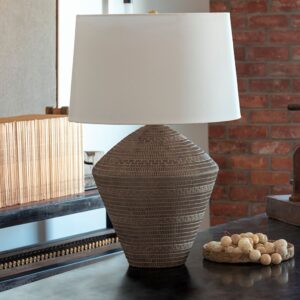
Multi-tier shades stack two or three progressively wider tiers on a single base, creating a pagoda-like silhouette associated with Asian-inspired and chinoiserie decorating traditions. The layered tiers produce multiple planes of light projection — ambient from between the tiers and directional from the lowest opening.
BEST FOR: Chinoiserie and Asian-inspired rooms, traditional and eclectic living rooms, global aesthetic spaces
How to Choose an Unusual Lamp Shade for Your Room
Choosing an unusual shade comes down to three factors:
- Light output: Unusual shades often produce less light than white fabric equivalents. Dark or opaque shades — cage, mercury glass, block print — work as accent lamps alongside a brighter primary source. Translucent shades — alabaster, art glass, paper — are ambient lamps. Only a light-colored fabric shade in an unusual shape (scalloped, ruffled, or square) maintains standard light output.
- Base compatibility: The shade must suit the fitter type on your base (spider, uno, or clip-on). An unusual shade does not change the fitter requirement. A stained glass shade uses its own fitter; most other unusual shades use a standard spider fitter on a harp.
- Room position: Unusual shades attract attention — position the lamp where you want the eye to travel. A coloured glass shade in a corner creates a focal destination. A ruffled shade beside a bed creates intimate drama. A cage shade on a desk states a design intention clearly.
Browse our full table lamps collection — every lamp arrives with a pre-matched shade. For floor-standing versions of many of these shade styles, our floor lamps collection applies the same design range at a taller scale. Pair a statement wall lamp with an unusual table lamp shade for a fully layered, distinctive lighting scheme. All orders ship free across the US via DHL, FedEx, or UPS.
Frequently Asked Questions About Unusual Lamp Shades
What makes a lamp shade “unusual” versus standard?
A standard lamp shade is a white or cream fabric drum or empire shape — neutral, functional, and designed to disappear into the room. An unusual lamp shade is defined by any deviation from this baseline: a distinctive colour (green, amber, light blue), an unexpected material (stained glass, alabaster, rattan, mercury glass), an unconventional shape (cage, multi-tier, scalloped, square), or an artisan surface treatment (block print, ruffled pleats, woven texture). Unusual shades are chosen to be noticed — they are the visual focal point of the lamp rather than its backdrop.
Do unusual lamp shades produce enough light for a room?
It depends on the shade type. Translucent unusual shades — art glass, alabaster, and paper — allow light to pass through the material and provide comparable ambient light output to fabric shades. Opaque or partial shades — cage, block print, and dark fabric colors — reduce light output significantly. Stained glass shades produce coloured, atmospheric light rather than functional task light. Use unusual shades as accent and ambient lamps alongside a brighter primary source unless you specifically want a dim, atmospheric effect.
Can I replace a standard shade on an existing lamp with an unusual shade?
Yes, provided the fitter type matches. Most unusual fabric shades — scalloped, ruffled, square, block print — use a standard spider fitter that attaches to a harp, and are compatible with any table lamp base that has a harp. Stained glass and art glass shades use their own specific fitter type and are generally not interchangeable with fabric shades. Cage and metal shades vary — check the fitter type before purchasing. For precise guidance, read our shade measurement and fitter guide before ordering a replacement.
Which unusual lamp shade is easiest to incorporate into any room?
A green lamp shade or a scalloped fabric shade in white or cream are the most accessible unusual options. A green shade on a brass or ceramic base is an iconic, time-tested pairing that works in traditional, transitional, and dark academic rooms without requiring any other design changes. A scalloped shade in a neutral color adds decorative detail without altering light output or color temperature — it reads as unusual in silhouette while remaining functionally standard. Both are strong choices for decorators who want a distinctive lamp without a dramatic room overhaul.
One thought on “Unusual Lamp Shades: 15 Statement Designs (2026)”