

Smart Table Lamps: Are They Worth It in 2026?
The question of whether a smart table lamp is worth buying in 2026 is really a question of what you need a lamp to do. Smart lamps — those with app control, voice assistant integration, color-changing LEDs, and automated schedules — have become genuinely capable in the past three years. But they have also created a new category of trade-off: convenience features versus design quality. A table lamp with USB port is the most modest step into smart lamp territory — built-in device charging at your bedside or desk without an additional outlet. At the other end of the spectrum, fully app-controlled color-changing lamps represent a different philosophy of home lighting entirely. This guide helps you decide which approach — smart, traditional, or a practical hybrid — is actually right for your home in 2026. Browse our table lamps collection for artisan-quality lamps across all tech-feature levels.
What “Smart” Means for a Table Lamp in 2026
The term “smart lamp” covers a spectrum of functionality. From most accessible to most complex:
- USB-equipped lamps
- Cordless/rechargeable lamps
- Dimmable lamps with smart switches
- Integrated smart bulb compatibility
- Fully integrated smart lamps
The Design Problem With Smart Lamps
Here is the trade-off that rarely gets stated clearly: the best-designed smart lamps are not particularly attractive, and the most attractive lamps are not particularly smart. This is because smart lamp technology — LED arrays, control panels, touch interfaces, speaker grilles, and proprietary app hardware — is almost impossible to conceal within the artisan materials that make a lamp visually compelling. A ceramic table lamp with a hand-applied glaze, a brass table lamp with aged metalwork, or a crystal table lamp with hand-cut facets — none of these accommodate a built-in Wi-Fi module without either compromising the material or producing an obvious design anomaly.
Smart lamps from mass-market brands tend to be plastic-dominant with limited material character — functional, capable, and forgettable as design objects. They work well in rooms where lighting technology is the priority and decorative quality is secondary — home offices, utility spaces, and rental rooms where a beautiful lamp is not the point.
In a room where the lamp needs to be a decorative anchor — a luxury table lamp on a console table, a marble table lamp on a nightstand, or a tiffany style table lamp in a library — smart technology in the base is almost never worth the design compromise.
The Smart Hybrid: The Best of Both Worlds
The approach that most interior designers and sophisticated homeowners actually use in 2026 is a hybrid: a beautiful traditional lamp with smart functionality added externally. This delivers the decorative quality of an artisan lamp alongside the convenience features of smart lighting, with no design compromise.
Method 1: Smart Bulb in a Traditional Socket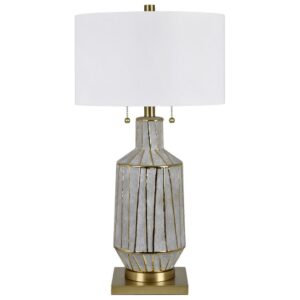
Replace the standard LED bulb in any E26 lamp with a smart bulb. Philips Hue, LIFX, and GE Cync all produce E26 smart bulbs in warm white (2700K) that are fully app-controlled and voice-assistant compatible. The Aged Brass Ceramic Meadow Ombre Table Lamp ($289–$439) with a Philips Hue warm white E26 bulb gives you full dimming, automated schedules, and voice control while maintaining the material quality and design character of an artisan ceramic lamp.
Method 2: Smart Plug on a Traditional Lamp
A smart plug (Amazon Smart Plug, Kasa EP25, or Meross) sits between the lamp cord and the wall outlet. It adds on/off scheduling, app control, and voice assistant compatibility to any plug-in lamp without touching the lamp itself. The Adorno Natural and Beige Table Lamp ($239–$359) on a smart plug becomes schedulable, app-controllable, and Alexa/Google compatible for the cost of a $15–$25 smart plug. This is the most cost-effective smart lamp upgrade available.
Method 3: USB Port as a Practical Convenience Feature
If the specific function you need is device charging on your nightstand without cord clutter, a table lamp with USB port in the base is genuinely useful — and some artisan lamp designs do incorporate USB ports without significantly compromising the base’s visual character. Look for models where the USB port is integrated into the socket fitting or positioned at the base’s rear rather than the front. The Aged Brass Dome Adjustable Desk Lamp ($269–$409) offers adjustable positioning and practical desk features while maintaining the brass material character that suits a premium home office surface.
Smart vs Traditional Table Lamp: Side-by-Side Verdict
| FACTOR | SMART LAMP | TRADITIONAL LAMP | VERDICT |
| Design quality | Plastic-dominant, minimal material character | Artisan materials — ceramic, brass, marble, crystal | Traditional wins |
| Convenience features | App control, scheduling, voice, and color-changing | None built-in — requires external upgrade | Smart wins |
| Design longevity | App dependencies may become obsolete in 3–5 years | No software dependency — endures indefinitely | Traditional wins |
| Hybrid potential | Limited — technology built-in, hard to separate | High — smart bulb or plug adds full functionality | Traditional hybrid wins |
| Price for quality | $80–$300 for capable smart lamps | $239–$509 for artisan traditional lamps | Similar investment tier |
| Bedroom use | Can disrupt sleep with LED glow and app notifications | Warm 2700K — designed for rest | Traditional wins |
| USB charging | Built-in on some models | Available on select artisan models | Table lamp with USB port |
| Renter-friendly | Yes — plug-in or battery models | Yes — plug-in standard | Both suitable |
Who Should Choose What: The Bottom Line
Choose a smart lamp if:
- You are furnishing a rental, student room, or utility space where decorative quality is secondary to function.
- You already have a tech-forward, minimalist interior where a sleek smart lamp’s design suits the room.
- You genuinely use voice-assistant integrations and automated schedules as part of your daily routine.
- You are buying for a home office where color temperature control (2700K to 6500K) for different tasks is a real need.
Choose a traditional artisan lamp with smart upgrades if:
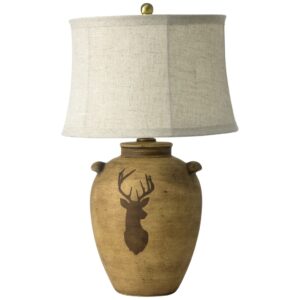
- You care about the lamp as a decorative object in a considered interior — a
- ceramic table lamp
- , a
- rustic table lamp
- , or a
- brass table lamp
- in a warm-toned living room or bedroom.
- You want smart functionality (dimming, scheduling, voice control) without sacrificing material quality — add a smart bulb or smart plug externally.
- You want the lamp to function as a design investment that does not become obsolete when a software platform changes.
- You need a table lamp with USB port as a practical convenience feature — look for artisan lamp designs that incorporate it cleanly into the base design.
Browse our full table lamps collection — every lamp uses a standard E26 socket compatible with smart bulbs from any brand. Our floor lamps collection applies the same artisan-quality standard at a standing height, also fully smart-bulb compatible. Contact info@exoticdecor.us Monday–Saturday, 10:00 AM–8:00 PM for recommendations on which artisan lamps work best with smart home integrations.
Frequently Asked Questions About Smart Table Lamps
Can I make any table lamp a smart lamp?
Yes — if the lamp has a standard E26 medium-base socket at 120V (the US standard for all residential table lamps), you can install a smart bulb from any major brand (Philips Hue, LIFX, GE Cync, Sengled) to add full app control, voice assistant compatibility, dimming, and scheduling. Alternatively, plug the lamp into a smart plug (Amazon, Kasa, Meross) for on/off scheduling and app control without replacing the bulb. These hybrid approaches deliver all the key smart lamp features while preserving the design quality of an artisan traditional lamp.
What is a table lamp with USB port?
A table lamp with USB port has one or more USB charging ports built into the base or socket fitting, allowing you to charge phones, tablets, earbuds, or other USB devices directly from the lamp without an additional outlet or cable. USB-C with Power Delivery charging (18W or higher) is the most useful specification for 2026 device charging speeds. Most USB-equipped lamps locate the port at the rear or base of the fixture to keep it visually discreet. This is the most accessible “smart” lamp feature and the one most easily integrated into an artisan lamp design without compromising material quality.
Are smart table lamps bad for sleep?
It depends on their configuration. A smart lamp set to warm white (2700K) at low brightness (450 lumens or below) in the hour before sleep produces a similar light quality to a traditional lamp at the same settings — not harmful for sleep. The risk comes from smart lamps set to cool white or blue-shifted light (4000K and above), which suppresses melatonin. Many smart lamps include a “sleep” or “wind down” preset that automatically shifts to warm, low-output light in the evening. If you use a smart bulb in a traditional lamp, program this setting manually in the app.
Are cordless table lamps considered smart lamps?
Cordless rechargeable table lamps are a form of smart convenience — they eliminate the cord entirely, giving complete placement freedom — but they are not inherently app-controlled or voice-compatible. Most cordless lamps use a simple on/off touch or button control. Some higher-end cordless models add dimming via touch-hold. Full app and voice control in a cordless lamp is rare and tends to appear only in premium smart-brand products rather than artisan designs. Cordless lamps are best understood as a practical placement convenience rather than a smart home integration.