

Console Table Lamps: Designer Placement Rules for Living Rooms
Console table lamps and living room lamp placement are the most frequently misunderstood elements of interior design in the American home. Getting them right requires following specific rules about height, scale, position, and spacing that professional designers apply instinctively but most homeowners discover only after buying the wrong lamp for the wrong position. The most common mistake: choosing a lamp based on how it looks in isolation, rather than how it relates to the surface it will sit on, the furniture around it, and the room it will anchor. At Exotic Decor USA, our living room table lamps collection is organized by size and placement — and this guide gives you the designer rules to choose the right lamp for every position.
The Five Living Room Lamp Positions: What Each Requires
Position 1: The Sofa End Table
The end table lamp beside the sofa is the most used lamp in any living room. The designer rule: shade bottom at 58–62 inches from the floor when the lamp is placed on the end table. This requires knowing two measurements — your end table height and your target shade height — before selecting a lamp.
- End table height 22 inches: Choose a lamp 36–40 inches total height (a tall, slim column). This is the
- End table height 24–26 inches: Choose a lamp 32–36 inches total height — the most common end table height range suits a standard column lamp.
- End table height 28–30 inches: Choose a lamp 28–32 inches total height. Higher-end tables need shorter lamps to keep the shade at the correct eye level.
The Aged Brass and Ceramic Affogato Table Lamp ($289–$439) suits the standard 24–26 inch end table at its natural height — aged brass hardware, warm ceramic table lamp body, empire shade at the correct eye level for sofa reading.
Position 2: The Console Table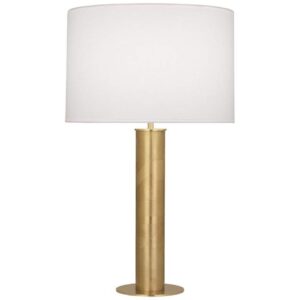
A console table lamps flanking a wall mirror is one of the most important lamp positions in a living room — it is seen from across the room, at standing height, and as part of a vertical composition with the mirror above. The designer rules:
- Lamp column height: The lamp column should reach at least two-thirds of the mirror height above the console surface. On a 48-inch-high mirror above a 30-inch console table lamps, the lamp column should extend to at least 32 inches (two-thirds of 48). This creates the vertical relationship between lamp and mirror that reads as proportionally resolved.
- Lamp width: The shade diameter should not exceed one-third of the console width. On a 48-inch-wide console, the shade bottom diameter should be 16 inches or less per lamp.
- Mirror relationship: The combined visual footprint of the two lamps and the mirror between them should occupy approximately 60–70% of the console width. Two lamps plus the negative space of the mirror between them create a triad composition — the most visually stable arrangement for a console.
For console lamp height: the Aged Brass Metal Modern Accent Table Lamp ($339–$509) in its taller specification is designed precisely for the console position — tall, architecturally slim, warm brass metal column that reads correctly from across the room. Buffet table lamps in slim 30–36 inch column format are the traditional choice for this position, and buffet table lamp pairs are among the most-searched living room lamp configurations.
Position 3: The Reading Corner
A reading corner lamp — beside an armchair, a chaise, or a window seat — has specific requirements that differ from the sofa end table. The shade bottom must be at the seated eye level of the specific chair, which varies by chair height (a high-back wing chair reads differently from a low Danish modern armchair). The practical approach: sit in the chair and measure the distance from the floor to eye level — this is the target shade bottom height.
For reading specifically, an adjustable lamp — like the Aged Brass Dome Adjustable Desk Lamp ($269–$409) — allows precise positioning of the light direction regardless of where the shade bottom sits. The dome directs light onto the page; the adjustable arm fine-tunes the angle. For a stationary artisan lamp in a reading corner: choose an empire shade rather than a drum shade — the empire directs light downward, the drum diffuses it in all directions.
Position 4: The Coffee Table
The coffee table lamp is the newest living room placement category — made possible by cordless table lamps for living room rechargeable designs that require no outlet access. The designer rule for coffee table lamps: compact and low, never blocking sightlines across the table. The maximum height for a coffee table lamp is 18 inches — the same height as the typical coffee table surface itself. A mini table lamp at 14–18 inches on a coffee table creates an intimate, candlelight-adjacent atmosphere after dark without obstructing the view across the table or the room.
Material choice matters more on a coffee table than at any other position: the coffee table lamp is the closest lamp to the seated guest, and it is examined at the closest range. A ceramic table lamp in an artisan glaze, a glass base table lamp in cobalt or mercury glass, or a wood table lamp in a natural grain are all appropriate for the coffee table position. A mini table lamp version in a high-quality material is the correct choice here.
Position 5: The Windowsill or Floating Shelf
Cordless table lamps have also created a new placement category: the windowsill or floating shelf at mid-wall height, 36–48 inches from the floor. A cordless table lamps for living room placed on a windowsill beside a sofa creates a warm ambient glow that reads as interior architectural lighting — something between a table lamp and a wall sconce. This position requires a compact lamp — 12–18 inches total height — and a shade that directs light inward rather than upward (to avoid washed-out window glare).
The Seven Designer Placement Rules
- Rule 1: No lamp should be the only object on its surface: A lamp alone on an end table reads as unfinished. The lamp anchors the surface; one or two additional objects (a book, a small plant, a tray, a sculptural object) complete it. The lamp is the tallest object; supporting objects should be progressively shorter.
- Rule 2: All shades in the room must be the same color: If there are four lamps in the living room — two end tables, two consoles — all four shade colors must match. All cream, all white, or all natural linen. Mixed shade colors across a room create visual inconsistency that reads as amateur.
- Rule 3: All hardware finishes in the room must coordinate: A
- Rule 4: Lamp heights do not all need to match: A
- Rule 5: No lamp should be pushed against the wall: A lamp on an end table beside a sofa should be centered on the table surface, not pushed to the back edge against the wall. Pushing a lamp to the back of an end table creates an imbalanced composition where the lamp and the wall compete. Centered on the surface, the lamp creates a composition with the table edges on all sides.
- Rule 6: Reading lamps need empire shades; ambient lamps need drum shades. An empire shade (tapered) directs light downward for focused reading. A drum shade (equal top and bottom diameters) diffuses light in all directions for an ambient atmosphere. Choose shade form based on function, not aesthetic preference.
- Rule 7: One lamp can break the formula: A
Living Room Lamp Placement Reference Guide
| POSITION | LAMP TYPE | HEIGHT | KEY RULE | COMMON MISTAKE |
| Sofa end table | Standard column lamp | 24–28″ | Shade bottom at 58–62″ from the floor | Lamp too short — shade below eye level |
| Console/sideboard | Buffet or tall column lamp | 28–36″ | Column reaches 2/3 of mirror height | Lamp too short — disappears beside the mirror |
| Reading corner | Empire shade or adjustable lamp | 24–30″ | Shade at seated eye level for that chair | Drum shade — diffuses, not directs, light |
| Coffee table | Mini or cordless compact lamp | 12–18″ | Below sightline — no view obstruction | Lamp too tall — blocks across-table views |
| Windowsill/shelf | Cordless compact lamp | 12–18″ | Directs light inward, not at the window | Lamp too tall — washes out with daylight |
Browse our complete living room table lamps range at Exotic Decor USA — every listing includes total height and shade diameter so you can match any placement position. For our complete living room lamp guide, see our cordless table lamps for living room pillar guide. Email info@exoticdecor.us Monday–Saturday, 10:00 AM–8:00 PM for room-by-room placement advice.
Frequently Asked Questions About Living Room Table Lamp Placement
How high should a table lamp be in a living room?
The shade bottom of a living room table lamp should sit at approximately 58 to 62 inches from the floor when placed on the end table beside a sofa. This positions the shade at the correct height for a lamp viewed from a seated position on a standard sofa. For a console table lamps, the shade bottom should relate to the mirror height above the console — the lamp column should reach approximately two-thirds of the mirror height. For a coffee table lamp, keep the total height below 18 inches to avoid blocking sightlines.
How many lamps should a living room have?
A living room typically needs three to five lamp positions: two end wood table lamps beside the primary sofa (one at each end), one or two console lamps against the wall, and optionally one reading corner lamp. No seated position should be more than 8 feet from a lamp. In a smaller living room under 200 square feet, two end table lamps and one floor lamp provide sufficient coverage. In a large living room with multiple seating groups, each group needs its own lamp anchor.
Should living room lamps be placed on both sides of the sofa?
Yes — bilateral symmetry is the designer standard for sofa lamp placement. A matched pair of lamps on identical end tables at both ends of the sofa creates the visual balance that a centered sofa and headboard composition requires. The only exception: if the sofa is positioned against a wall at one end with no room for an end table, a single lamp at the free end is acceptable. In this case, a taller lamp or a floor lamp at the opposite corner provides the light coverage that the second table lamp would have delivered.
Can I put a table lamp on a coffee table?
Yes — with one condition: keep the total lamp height at or below 18 inches. A compact or cordless table lamps at coffee table height creates an intimate atmospheric quality after dark without blocking sightlines across the table or the room. For coffee table lamps, cordless rechargeable designs are particularly practical because coffee tables are rarely close to wall outlets. Choose a lamp with a shade that directs light downward or sideways rather than upward — upward-directed light on a coffee table creates glare at sofa level.