

Coffee Table Sculpture: How to Style Your Living Room Centerpiece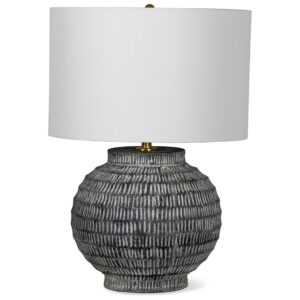
The coffee table sculpture is the most examined surface in the living room. Every person who sits on the sofa looks at it. Every guest sees it first. And yet most coffee tables in American homes are either empty or covered in the kind of clutter that arrived temporarily and never left: a remote control, a magazine from two months ago, a candle that has never been lit. A coffee table sculpture is how you make that surface intentional. It is the difference between a surface and a composition, and it is one of the easiest design moves available to you. Pair it with the right table lamp on the end table and you have a living room that looks genuinely designed.
The key rules for coffee table sculpture styling are scale, material, and the number three. No single rule matters more than scale, and most people get it wrong in the same direction: they choose something too small. A 6-inch ceramic figure on a 48-inch coffee table sculpture looks like it got misplaced. A 10-inch sculptural coffee table piece on the same table reads as intentional. The Aged Brass Dome Adjustable Desk Lamp ($269-$409) shows the right scale principle in lamp form: proportioned to the end table, not to the room, and immediately right for its position.
Scale Rules for Coffee Table Sculpture
The maximum height rule: the tallest object on your coffee table sculpture should be no more than 1/3 the height gap between the table surface and the sofa seat cushion. On a standard 16-inch coffee table with a sofa seat at 18 inches, that gap is 2 inches — meaning very short objects only. But most coffee tables are actually 18 to 20 inches tall, while sofa seats are 17 to 19 inches. In this configuration, the top of the coffee table and the seat are roughly equal, and the maximum object height is approximately 6 to 8 inches. The Aged Brass Ceramic Meadow Ombre Table Lamp ($289-$439) in warm meadow ombre stands about 24 inches — exactly right for an end table, but too tall for a coffee table; it belongs on the side, not the center.
Within that 6 to 8-inch maximum, vary the heights of your coffee table objects. Place the tallest object at one end of the table, a medium-height piece at the other, and a low object — a small tray, a flat dish, a low book — in between. This graduated height variation reads as a composed arrangement rather than a random collection. The Cobalt and Natural Brass Table Lamp ($269-$409) with its cobalt glass body and warm brass hardware is the kind of jewel-toned object that anchors a coffee table at a low-to-medium height.
Materials and Styles for Coffee Table Sculpture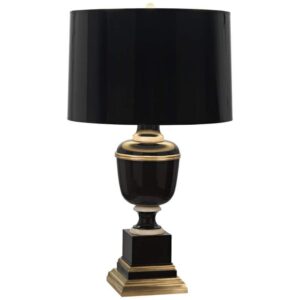
Abstract resin and ceramic wall sculpture art forms are the most versatile coffee table objects — they are sculptural enough to function as art, practical enough to avoid looking precious, and available in a wide enough range of colors and forms to suit any room palette. A smooth organic resin form in a warm earth tone beside a stack of art books and a small candle is the archetypal coffee table composition. The Adobe Brown Chisel Ceramic Table Lamp ($269-$409) in warm terracotta-adjacent adobe brown is the lamp version of this same earthy, resolved palette.
Stone and marble objects — spheres, bowls, bookends, small carved pieces — add a physical weight to a coffee table composition that lighter materials cannot match. A marble sphere the size of a grapefruit on a coffee table reads as permanent and substantial; a resin sphere of the same size reads as lighter and more casual. Choose stone and marble objects for rooms that trend toward the formal or transitional end of the spectrum. The High Hammock Pale Blue Ceramic Table Lamp ($319-$479) in high hammock pale blue ceramic has that same substantive material quality in lamp form.
Glass and crystal objects create the lightest and most jewel-like coffee table compositions — they catch the light from the windows and the lamp on the end table and throw it back into the room as prismatic reflections. They suit contemporary, transitional, and maximalist rooms better than farmhouse or organic modern ones, where the heaviness and weight of resin or stone reads more naturally. The Possini Euro Zeus Gold Leaf Modern Table Lamp ($319-$479) with its gold leaf textured base creates this same jewel-toned presence in lamp form.
How to Build a Coffee Table Vignette
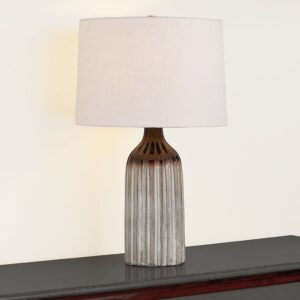
The triangle rule: place three objects of different heights at the three points of an imaginary triangle on the coffee table surface. The tallest object at the back, the medium object at one front corner, and the lowest at the other front corner. This creates depth (front-to-back) and bilateral variation (left-to-right) in the composition simultaneously. Start with the anchor piece — usually the most substantial or most sculptural object — at the back position. The Aged Brass and Ceramic Affogato Table Lamp ($289-$439) with its brass column and ceramic body creates this kind of anchor quality at a side table scale.
Material variation within the grouping is as important as height variation. A coffee table composition of three ceramic objects reads as monolithic even if the forms are interesting. A composition of one ceramic piece, one wood piece, and one glass piece creates the material conversation that makes a vignette engaging. The rule of material variation: no two adjacent objects in a coffee table grouping should be made from the same material. The Adorno Natural and Beige Table Lamp ($239-$359) in warm beige adds exactly the kind of natural ceramic contrast that balances a wood or stone primary object.
Leave negative space. A coffee table that is fully covered in objects looks cluttered regardless of how individually beautiful each object is. Leave at least 30 to 40 percent of the table surface empty. The negative space is as important as the positive form. The Adeline Five Gold Flowers Bloom Metal Table Lamp ($269-$409) with its five gold petal forms demonstrates the same principle: the spaces between the petals are as important as the petals themselves.
Browse our table lamps collection for sculptural table lamp bases that complete your living room composition. For the full wall art context, see our
Frequently Asked Questions
What should I put on a coffee table as a sculpture?
Choose one sculptural piece as the anchor — an abstract resin form, a stone sphere, a ceramic vessel, or a carved wood object. Add two supporting objects at different heights to create a triangle composition. Vary the materials: ceramic with wood, glass with stone, resin with metal. Keep the tallest object under 6 to 8 inches and leave at least 30 percent of the table surface empty. The lamp on the adjacent end table is part of the same composition — coordinate its material finish with the coffee table objects.
How do you style a coffee table?
Use the triangle rule: three objects at three points, graduated in height from tall at the back to low at the front. Vary materials — never two objects from the same material adjacent to each other. Leave 30 to 40 percent of the surface empty as negative space. The maximum object height is 1/3 the gap between the table top and sofa seat cushion height. Start with the anchor piece (heaviest or most sculptural), then add supporting objects.
What is a coffee table sculpture?
A coffee table sculpture is a three-dimensional art object placed on a sculptural coffee table as both a functional object and a design element. It differs from random table clutter in that it is chosen deliberately for its form, material, and relationship to the other objects in the composition. Types include abstract resin forms, stone and marble pieces, glass and crystal objects, ceramic figures, and small cast bronze pieces.
Should coffee table objects match?
No — contrast is more interesting than matching. Three objects of the same material read as monotonous even when the forms are different. Vary materials (ceramic, wood, glass, stone), vary heights (tall, medium, low), and vary textures (smooth, rough, transparent, matte). The only thing that should be consistent is the color temperature: warm tones (amber, terracotta, brass, warm wood) or cool tones (pale gray, white, glass, steel), but not a mixture of both in one composition.