

What to Look for When Buying Sculpture Art: Quality, Authenticity, and Condition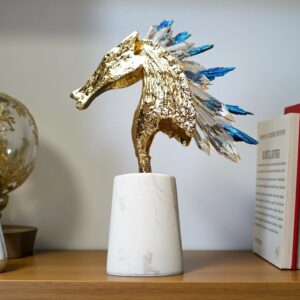
Knowing what to look for when buying sculpture art separates confident collectors from buyers who rely entirely on the seller’s description. Most of the information you need to make a quality judgment is available in the object itself — if you know where and how to look for it. A quality bronze will show you its quality at close range. A quality ceramic will tell you whether it was made with intention or manufactured with indifference. The Cobalt and Natural Brass Table Lamp ($269–$409) in cobalt glass and natural brass is an object that shows its quality — the light-interactive glass, the warm brass hardware, and the scale relationship between them all communicate considered design.
This guide covers what to look for when buying sculpture art — quality assessment methods, authenticity signals, provenance checking, condition evaluation, and red flags that indicate a poor purchase. Browse our table lamp collection for sculptural lamp designs that demonstrate the qualities this guide asks you to look for.
What to Look for When Buying Sculpture Art: Quality Assessment
Sculpture quality assessment guide principles apply before you ask about price or provenance. Examine the surface under natural sidelight at 6 to 12 inches. A quality piece reveals more detail, more texture variation, and more evidence of conscious material decision-making at close range than at normal viewing distance. A poor-quality piece reveals its limitations at close range: uniform machine-smoothness where hand-working should be visible, painted-on surface treatment that does not read as integral to the material, or visible casting defects (air bubbles, rough areas) in bronze or resin work.
The weight-to-size ratio test applies to all sculptural objects: pick up the piece and assess whether it feels appropriate for its material. Real marble, genuine cast stone, and quality cold-cast bronze all feel heavier than their size suggests. Factory-produced painted resin feels lighter than its appearance implies. If a piece is described as bronze or stone but feels much lighter than it looks, it is almost certainly a lower-quality material than described. The Aarna Black Table Lamp ($269–$409) in matte black aarna demonstrates this quality principle — the lamp base has the weight appropriate to its stated material.
Evaluating Sculpture Authenticity and Provenance
Evaluating sculpture authenticity differs depending on what type of piece is being purchased. For reproduction pieces of public-domain works (Rodin, Michelangelo, Brancusi), authenticity is about quality of production rather than origin — the question is whether it is a good reproduction of the original, not whether it is the original. For limited-edition artist sculptures, authenticity means: is this genuinely from the stated edition, and does it come with documentation confirming it? For original one-of-a-kind works, authenticity requires provenance documentation.
Provenance checking for sculpture in the mid-to-high price range requires requesting: a bill of sale from the point of original purchase, any exhibition history documentation, and a letter from the artist or their estate if the artist is living or recently deceased. Artist certificate of authenticity from a recognized sculptor (signed and numbered certificate linking the certificate to the specific piece) is the minimum standard for any limited-edition work over $500. Without it, the piece has no documented edition identity. The Aged Brass Metal Modern Accent Table Lamp ($339–$509) in slim modern accent brass is the lamp for the collector’s study where these documents are evaluated and filed.
Sculpture Condition Checklist Before Buying
What to look for when buying sculpture art includes a systematic condition assessment. Sculpture condition checklist: examine for cracks (hairline or structural), chips (surface only or through-body), repairs (patches, fills, repaints visible at close range), and active deterioration (active bronze disease, flaking ceramic glaze, ongoing stone spalling). All of these conditions reduce value and some indicate ongoing deterioration that cannot be halted without professional conservation.sculptural table lamps
Checking sculpture before buying also means evaluating the stability of the base. Place the piece on a flat surface and confirm it sits without rocking. A rocking base is either a manufacturing defect or a sign of damage at the base. Check all edges and any projecting elements (arms on figurines, thin legs on animals) for existing chips or repaired chips — these are the most fragile areas and the most commonly damaged in shipping. The High Hammock Pale Blue Ceramic Table Lamp ($319–$479) in pale blue ceramic creates the close-range examination light that reveals condition issues in any sculptural object.
Sculpture Red Flags When Buying
Sculpture red flags when buying: a seller who cannot answer specific questions about production method; weight that is clearly inappropriate for the stated material; a patina that looks painted on rather than integral; a “certificate of authenticity” that is printed rather than signed by the artist (printed certificates can be produced without artist involvement); price that is significantly below market for the stated material quality; and photography that avoids close-range surface shots (a sign the seller knows the surface will not pass close examination).
The one question that separates quality sellers from poor ones: “Can you tell me specifically how this piece was produced?” A quality seller of bronze will tell you the casting method. A quality seller of ceramic will tell you the clay body, firing temperature, and glaze type. An inability to answer this question with specifics is the most reliable single indicator that the piece’s quality does not match its price. Browse our full lamp collection for the complete collection of sculptural lamp designs from a source that answers these questions clearly.
What to look for when buying sculpture art is readable in the object if you know where to look. Surface at close range, weight relative to size, base stability, condition at edges and projecting elements, and the seller’s ability to answer production questions specifically — these five checks separate quality purchases from disappointing ones. Browse our full lamp collection for the complete collection.
Frequently Asked Questions
How do you assess the quality of a sculpture before buying?
Examine the surface under natural sidelight at 6 to 12 inches — quality reveals more detail and more evidence of conscious making at close range. Test the weight-to-size ratio: real marble, cast stone, and cold-cast bronze feel heavier than their size suggests. Examine all edges and projecting elements for chips or repairs. Check that the base sits flat without rocking. Ask the seller specifically how the piece was produced: an inability to answer with specifics is the most reliable quality warning sign.
What should a certificate of authenticity include for a sculpture?
A genuine artist certificate of authenticity should be physically signed by the artist (not printed), identify the specific piece by title and unique identifier, state the edition number and total edition size, confirm the material and production method, and be dated. A printed certificate without an original artist signature has no authentication value — it can be produced by anyone. For limited-edition works over $500, refuse any purchase without a properly signed certificate linking it to the specific numbered piece.
What are the warning signs of a poor-quality sculpture?
Sculpture red flags when buying: seller cannot describe production method specifically; weight clearly inappropriate for the stated material; patina appears painted on rather than integral; certificate of authenticity is printed rather than hand-signed; price significantly below market for the stated quality; photography avoids close-range surface shots. On the piece itself: visible air bubbles in bronze casting, uniform machine smoothness where hand-working should be visible, color applied as a surface coat rather than integral to the material.