

Rodin Sculptures: The Complete Guide to His Greatest Bronze Works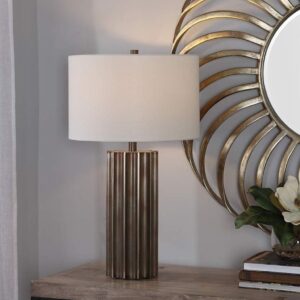
Auguste Rodin transformed sculpture. Before him, European sculpture was largely defined by two traditions: the classical academic tradition (idealized figures in approved materials) and the public monument tradition (heroic figures on pedestals commemorating specific events). Rodin challenged both simultaneously. His Burghers of Calais abandons the conventional pedestal entirely, placing life-size figures at ground level so they stand among the viewer rather than above them. His Gates of Hell treats a doorway as a total work of art populated by dozens of figures, many of which became independent works. His portraits — of Balzac, of Victor Hugo — achieve a psychological intensity that previous portrait sculpture had never attempted. Rodin sculptures define what it means to take bronze seriously as an expressive medium. The Aged Gunmetal Fluted Table Lamp ($299–$449) in aged gunmetal creates the dark, precise material register that Rodin’s bronze sculpture aesthetic belongs beside.
This piece covers Rodin’s greatest works — The Thinker, The Kiss, the Burghers of Calais, the Balzac, The Gates of Hell — explains what Rodin achieved with each, and explores what the Rodin bronze aesthetic means for a study or library that takes intellectual work and serious art seriously. Browse our table lamps collection for lamp designs suited to such a room.
The Gates of Hell and What Grew From It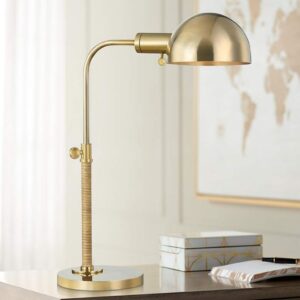
The Gates of Hell commission in 1880 gave Rodin a frame — literally and figuratively — for an extraordinary creative period. Commissioned for a decorative arts museum that was never built, the gates became a laboratory for Rodin’s explorations of form, movement, and psychological expressiveness. Over 200 individual figures appeared in various versions of the gates over the following decades, and many of these figures were separately cast and exhibited as independent works. The Thinker, The Kiss, The Three Shades, Fugit Amor — all originated in the gates commission and all achieved independent status as Rodin sculptures. The creative abundance of this period is unmatched in the history of the thinker sculpture. The Bronze Accent Table Lamp ($239–$359) in warm aged bronze accent is the material echo of the Rodin bronze patina in lamp form.
The Kiss (1882) is formally the opposite of The Thinker: where the Thinker is solitary, weighed down, and contemplative, the Kiss is mutual, weightless-seeming, and celebratory. The two figures — derived from Paolo and Francesca in Dante’s Inferno — interlock so precisely that the marble appears to be a single continuous form. The surface is smooth, warm, and luminous — Rodin used a finer finish on The Kiss than on almost any other work, because the emotional register required a different surface. The Aged Brass Dome Adjustable Desk Lamp ($269–$409) on the desk beside a quality Rodin reproduction creates the specific light quality that reveals this surface difference.
Rodin Sculptures: The Burghers of Calais and Public Art
The Burghers of Calais (1884–1895) is Rodin’s most radical public commission and, arguably, his most important work. The commission was for a monument to six citizens of Calais who offered themselves as hostages to Edward III of England to spare the city. Rodin’s solution was to show the six figures not as heroes but as human beings facing death: exhausted, frightened, resigned, determined — each one differently, each one fully realized as an individual rather than a type. And he removed the pedestal, placing the six figures at street level, among the people who would walk past them. The Aged Black Table Lamp ($269–$409) in dark, receding matte black is the lamp for the room where the Burghers is understood: one that values honesty and gravity over decoration.
Rodin Sculptures in Your Home: The Aesthetic Principles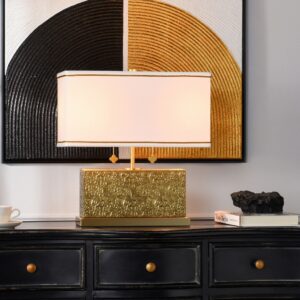
A room that takes Rodin seriously — that aspires to the quality of weight, psychological depth, and material honesty his bronzes embody — should be built around similar principles. Dark, warm materials: aged bronze, dark oak, aged leather, linen. Deliberate scale: objects large enough to demand attention. Objects with genuine expressive quality rather than decorative prettiness. And the discipline to include only what earns its place. Browse our sculptural table lamps for sculptural lamp designs built on these same principles.
For the complete guide to the world’s most famous sculptures and their design legacy, see our famous sculptures guide.
Frequently Asked Questions
What are Rodin’s most famous sculptures?
Rodin’s most famous sculptures are The Thinker (1880/1904), The Kiss (1882), the Burghers of Calais (1884–1895), The Gates of Hell (worked on from 1880 until his death in 1917), and the Balzac (1898). The Thinker and The Kiss exist in multiple authorized casts worldwide. The largest collection of Rodin’s work is at the Musée Rodin in Paris, which includes his house, studio, and garden — one of the finest sculpture gardens in Europe.
Where can I see Rodin’s sculptures?
The Musée Rodin in Paris has the largest collection and includes Rodin’s studio house and garden. The Rodin Museum in Philadelphia has an excellent collection in a significant Beaux-Arts building. The Legion of Honor in San Francisco and the Stanford University Cantor Arts Center both have important collections. Many major art museums worldwide hold individual Rodin bronzes. Most large-scale works exist in multiple authorized casts, making Rodin one of the most accessible of the major sculptors.
What material did Rodin use for his sculptures?
Rodin worked primarily in bronze, using the lost-wax casting process that allows surface detail at the level his work required. He also worked extensively in marble, particularly for The Kiss and The Hand of God. His working method involved first modeling in clay or plaster, then working with highly skilled craftsmen who enlarged and cast in both bronze and marble. The patina on Rodin bronzes — the controlled dark surface — is as important as the form itself and is carefully maintained by museum conservators.
Did Rodin make The Thinker?
Yes. The Thinker was created by Rodin beginning around 1880 as part of his Gates of Hell commission, where it appeared above the lintel as a figure of the poet Dante. Rodin enlarged it to standalone scale and it became one of the most recognized sculptures in history. Authorized bronze casts of the full-size Thinker exist at the Musée Rodin, the Cleveland Museum of Art, Stanford University, and over 20 other institutions worldwide.