

Table Lamp Wattage and Bulb Guide: LED, E26, and How to Choose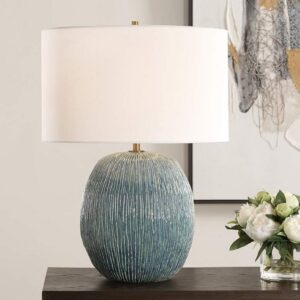
Table lamp wattage is the question buyers ask most often after choosing their lamp design — and the one that reveals how completely LED technology has changed home lighting. In the incandescent era, wattage was a meaningful proxy for brightness. In the LED era, wattage tells you almost nothing useful — an 8-watt LED produces the same brightness (800 lumens) as a 60-watt incandescent. The Meadow Ombre Table Lamp ($289) in warm meadow ombre accepts E26 base bulbs — the correct choice is an LED at 8 to 10 watts producing the same brightness at a fraction of the energy draw.
Browse our lamp collection for the complete table lamp collection — all with E26 standard US base.
LED vs Incandescent Equivalents
Shop for bulbs by lumens (brightness), not watts (energy). For a table lamp as ambient light: 800 lumens is the target — the brightness of a 60-watt incandescent or an 8 to 10-watt LED. For reading lamps at close range: 1100 lumens (75-watt incandescent equivalent or 12 to 14-watt LED). For very small accent lamps or nightstand lamps for ambiance only: 450 to 500 lumens (40-watt equivalent or 6-watt LED). All exoticdecor.us table lamps use the E26 standard US base. The Adorno Natural Beige Table Lamp ($239) in warm Adorno ceramic at $239 accepts the same E26 format and demonstrates correct ambient brightness at 800 lumens.
Color Temperature: 2700K vs 3000K vs Daylight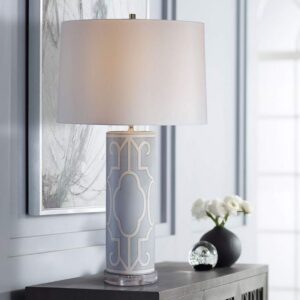
Color temperature (in Kelvin) is the second most important bulb specification after brightness. For living room and bedroom table lamps: 2700K (warm white) is the standard — it creates the amber-gold light quality most associated with relaxation and domesticity. For home office and task lamps: 3000K (soft white) creates slightly cooler, crisper light supporting alertness. Never use daylight (5000K) or cool white (4000K) in bedroom lamps — these suppress melatonin. The Zeus Gold Leaf Table Lamp ($319) in warm Zeus gold leaf at 2700K demonstrates the amber-gold lamp quality at its most beautiful.
E26 vs E12 vs Other Lamp Bases
The E26 medium base is the US standard for table lamps — the same base used in most ceiling fixtures, floor lamps, and pendant lights. All exoticdecor.us table lamps use the E26 base. E12 (candelabra base) is smaller, used in chandelier arms, wall sconce candelabra sockets, and some small accent lamps. A GU10 or other pin-base format is not compatible with the standard table lamp socket — always confirm the base type before purchasing replacement bulbs. The Cobalt and Natural Brass Table Lamp ($269) in warm cobalt and brass uses the standard E26 base and accepts any E26 LED at 8 to 10 watts.
Browse our full lamp collection for all table lamps — all with E26 standard US base and warm-white LED compatible.
Frequently Asked Questions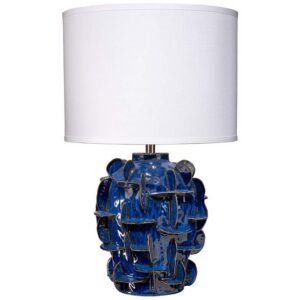
What wattage bulb do I need for a table lamp?
For ambient table lamps (living room, bedroom), use an LED bulb for table lamp producing 800 lumens — typically an 8 to 10-watt LED, equivalent in brightness to a 60-watt incandescent. For reading and task lamps: 1100 lumens (12 to 14-watt LED). For accent-only bedside lamps: 450 to 500 lumens (6-watt LED). Check the maximum wattage label on the lamp socket and never exceed it.
What does E26 mean on a table lamp?
E26 table lamp bulb is the US standard medium base — the screw-in socket that accepts standard household light bulbs. The “E” stands for Edison and “26” is the base diameter in millimeters. All standard US household LED, CFL, halogen, and incandescent bulbs in medium base format use the E26 socket. All exoticdecor.us table lamps use the E26 base.
What color temperature is best for table lamps?
2700K (warm white) is recommended for living room and bedroom table lamps — it creates the amber-gold light quality most associated with relaxation. 3000K (soft white) is slightly cooler and crisper, better for home office and task lamps. Never use 4000K (cool white) or 5000K (daylight) in bedroom lamps — they suppress melatonin production and make winding down harder.